
Resource · Organizational workflows
Design agentic workflows around real decisions
A reliable workflow gives each stage a bounded job and an observable output. This guide covers the parts needed to make agentic product work useful in an organization.
Begin with the decision the workflow serves
Define the user, outcome, required evidence, and stopping boundary before selecting agents or tools.
Give every stage a testable responsibility
Specify the role, task, context, method, output, and quality boundary. Add a gate when a consequential commitment or external action occurs.
- Prefer narrow roles
- Use structured outputs where downstream work depends on them
- Report partial and failed actions truthfully
See the practice in context
The workflow makes responsibility and transitions visible from start to finish.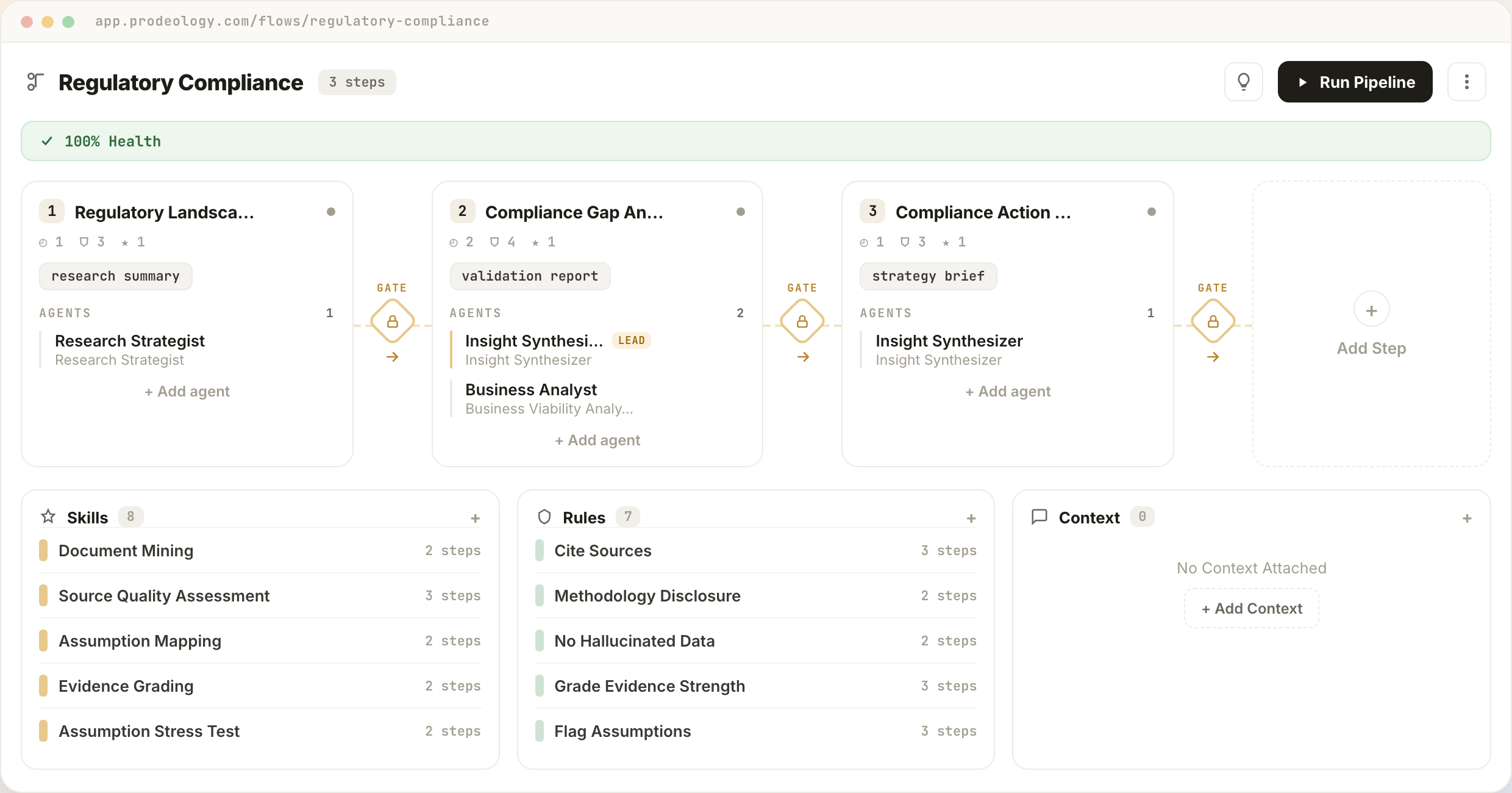
Review the whole system
A strong prompt cannot compensate for missing context, excessive authority, weak validation, or an unclear handoff.
Test the transitions
Inspect what each stage receives, what it must produce, and what happens when evidence is missing or a tool action fails. The handoff should preserve uncertainty and make partial work visible; downstream stages should not treat an incomplete output as an approved fact.
More agents do not mean better work
Use the simplest workflow that meets the decision's needs. Add stages only when they solve an observed quality or control problem.